
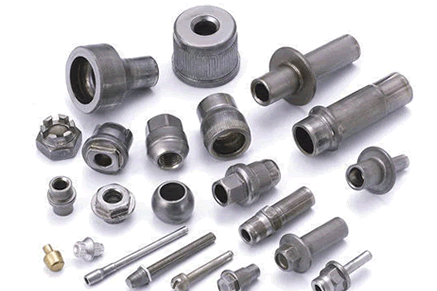
Cold forging is a critically important manufacturing process used to shape metal parts at room temperature or slightly above room temperature. It induces microstructural changes that can greatly influence material properties. Unlike hot forging, which involves heating the metal above its recrystallization temperature, cold forging relies on the plastic deformation of the metal at lower temperatures. Common types of cold-forging processes include: cold heading, cold extrusion, coining, swaging, and cold forging with rolling.
This article will discuss what cold forging is, its process, materials used, types, and advantages.
What Is Cold Forging?
Cold forging, cold forming, or cold heading is a class of metalworking processes. It is used to shape metal parts at room temperature or slightly above, by plastic deformation of the metal to force it to reflect the shape and dimensions of a tool used for the purpose.
What Is the Process of Cold Forging?
Listed below is the process of cold forging:
Initial State: The metal consists of a crystalline structure, typically arranged in a lattice pattern. These crystals, or grains, have well-defined boundaries. As a rule, cold forging is applied to the material in an annealed or normalized state, in which grain sizes are maximized, resulting in optimum ductility.
Application of Stress: When external pressure or impulse is applied during cold forging, it causes the metal grains to deform and slip at planar faces and grain boundaries. This allows deformation to occur.
Grain Deformation: As the external force is applied, the grains begin to deform. Dislocations, or defects, form within the crystal lattice as atoms are pushed out of their original positions. This process disrupts the crystal lattice structure, causing atoms to move and dislocate within the lattice planes. It can result in work hardening, in many materials, so the typical crystal size is smaller and there are large residual stresses at the grain boundaries.
Plastic Flow: As deformation continues, the dislocations move and interact with each other, allowing the metal to flow and reflect the shape of the die cavity. This plastic flow occurs along slip planes within the crystal lattice, in which atoms can easily rearrange themselves without fracture, in more ductile materials.
Grain Refinement: The deformation process also leads to grain refinement, in which the original larger grains are broken down into smaller, typically more uniform grains. This refinement improves the mechanical properties of the material, such as strength and hardness (work hardening).
Cold forging at a crystalline level involves the controlled deformation of metal grains through the movement of dislocations within the crystal lattice structure. This process results in the shaping of the metal into the desired form while improving its mechanical properties.
What Is the Temperature Used in Cold Forging?
Cold forging is performed at room temperature or slightly above room temperature. The process relies on the plastic deformation of the metal at lower temperatures. The specific temperature range for cold forging can vary depending on the type of metal being forged, its properties, and the requirements of the manufacturing process. In general, cold forging is performed at temperatures below the recrystallization temperature of the metal. Only a limited number of alloys, generally with a high lead (Pb) content, can undergo recrystallization at room temperature. This process exploits controlled plastic deformation of the metal without the need for heat-softening and resulting fracture.
For most metals, cold forging is carried out within the range of 20 °C to 200 °C. At these temperatures, the metal retains its strength and hardness. This allows for precise shaping and forming of parts while minimizing the risk of material degradation or loss of mechanical properties.
How Does Temperature Control Affect Cold-Forged Component Quality?
Temperature control plays a crucial role in cold-forging processes and can significantly affect the quality of cold-forged components. It helps maintain the appropriate material ductility, formability, dimensional accuracy, microstructure, and surface finish. For example, too low a temperature can increase deformation resistance, leading to tool wear and part defects. Too high a temperature, on the other hand, can cause the material to soften excessively, resulting in poor dimensional accuracy and surface finish. By carefully controlling temperature parameters throughout the forging process, manufacturers can produce high-quality components with little need for post-work.
What Are the Materials That Can Be Cold Forged?
Choosing the most appropriate material for a process involves complex decision-making, depending on a range of factors. Listed below are some of the materials used in cold forging:
1. Aluminum
Cold forging of aluminum alloys involves shaping metal parts at room temperature or slightly above. Aluminum alloys are chosen for cold forging based on the properties of the grade and its suitability for cold forging. Commonly used aluminum alloys for cold forging include: the 1xxx, 3xxx, 5xxx, and 6xxx series, all of which offer good formability, strength improvement through forging, and corrosion resistance in mild environments.
Overall, cold forging of aluminum alloys offers advantages such as: improved mechanical properties, dimensional accuracy in a one-stage process, and good surface finish compared to traditional machining processes. It is widely used in industries such as: automotive, aerospace, and consumer electronics for producing a huge variety of moderate-stress components with complex shapes and tight tolerances.
2. Steel
Cold forging of steel also involves shaping metal parts at room temperature or slightly above. Material selection of steel alloys is based on the alloy properties and known suitability for cold forging. Commonly used steel alloys for cold forging include: medium- and high-carbon steels, various alloy steels, and stainless steels, which offer good formability, strength, and durability.
Cold forging of steel delivers improved mechanical properties, high dimensional accuracy, and good surface finish compared with traditional machining processes. It is widely used in: automotive, aerospace, construction components, and industrial product manufacturing for producing components with complex shapes, beneficial grain characteristics, good mechanical properties, and tight tolerances.
3. Titanium
Cold forging of titanium also involves shaping one-stage finished parts at room temperature or slightly above. Titanium alloys are chosen based on alloy properties and suitability for cold forging. Titanium alloys such as Ti-6Al-4V (Grade 5), Ti-6Al-6V-2Sn, and Ti-6Al-2Sn-4Zr-2Mo offer good formability, strength, and excellent corrosion resistance, making them suitable for cold forging.
Cold forging of titanium offers significant advantages over alternative net-shape manufacturing methods. It delivers improved mechanical properties, high dimensional accuracy, and good surface finish compared, for example, to CNC machining. It is used in: aerospace, medical, and automotive components for producing parts with complex shapes and high strength-to-weight ratios.
The cold forging of titanium requires more skill than for most other metals and requires more specialized equipment and tooling due to the material’s unique properties and challenges.
4. Copper
Cold forging of copper at room temperature or slightly elevated levels is used to make finished parts of high cosmetic and engineering quality. Copper alloys are selected for this approach based on ductility, defining suitability for cold forging. Commonly cold-forged copper alloys include: C10100 (oxygen-free electronic copper), C11000 (electrolytic tough pitch copper), and C36000 (free-cutting brass). These alloys offer good formability, conductivity, and corrosion resistance.
Cold forging of copper offers advantages such as: improved mechanical properties, dimensional precision without post-processing, and controllable surface finish/texture, relative to other net-shape manufacturing methods. It is used in electronics, plumbing, automotive, and construction for producing components with high thermal and electrical conductivity, corrosion resistance, and tight tolerances. Additionally, cold forging of copper is an environmentally friendly process as it requires minimal energy consumption and produces little to no waste.
5. Brass
Brass is also forged at room temperature. This again produces low post-work parts of high quality. Brass alloys are chosen based on their ductility as suitable for cold forging. Brass alloys for cold forging include: C36000 (free-cutting brass), C46400 (naval brass), and C69300 (high-copper alloy). These alloys offer good formability, machinability whenever required, and generally good corrosion resistance.
Cold forging of brass results in improved mechanical properties, dimensional accuracy, and good surface finish compared to traditional machining processes. It is used for: plumbing components, automotive parts, electrical components, and various decorative and functional hardware. Brass offers good corrosion resistance, good electrical and thermal conductivity, good functional strength, wear resilience, and decorative appearance. Once again, this is an environmentally friendly process as it requires minimal energy consumption and produces little to no waste.
6. Stainless Steel
cURL Too many subrequests.
cURL Too many subrequests.
cURL Too many subrequests.
cURL Too many subrequests.
cURL Too many subrequests.
cURL Too many subrequests.
cURL Too many subrequests.
cURL Too many subrequests.
cURL Too many subrequests.
cURL Too many subrequests.
cURL Too many subrequests.
cURL Too many subrequests.
cURL Too many subrequests.
cURL Too many subrequests.
cURL Too many subrequests.
cURL Too many subrequests.
cURL Too many subrequests.
cURL Too many subrequests.
cURL Too many subrequests.
cURL Too many subrequests.
cURL Too many subrequests.
cURL Too many subrequests.
cURL Too many subrequests.
cURL Too many subrequests.
cURL Too many subrequests.
cURL Too many subrequests.
cURL Too many subrequests.
cURL Too many subrequests.
cURL Too many subrequests.
cURL Too many subrequests.
cURL Too many subrequests.
cURL Too many subrequests.
cURL Too many subrequests.
cURL Too many subrequests.
cURL Too many subrequests.
cURL Too many subrequests.
cURL Too many subrequests.
cURL Too many subrequests.
cURL Too many subrequests.
cURL Too many subrequests.
cURL Too many subrequests.
cURL Too many subrequests.
What Are the Typical Applications of Cold Forging in Various Industries?
Cold forging is employed across most metal manufacturing sectors for producing a huge range of components. Some typical applications include:
Automotive: Fasteners (bolts, nuts, screws), steering and suspension parts (tie rods, ball joints), engine components (connecting rods, crankshafts), transmission parts (gears, shafts), and brake system components (caliper bolts, pistons).
Aerospace: Aircraft fasteners (rivets, bolts, pins), landing-gear components (struts, hinges), engine parts (turbine blades, compressor discs), and structural fittings and brackets.
Construction: Structural connectors (bolts, anchor bolts), fasteners for construction applications (screws, nails), metal brackets, and hangers, and window and door hardware.
Electronics and Electrical: Electrical contacts and connectors, terminal pins and sockets, heat sinks and cooling components, and sensor housings and mounting brackets.
Medical: Orthopedic implants (bone screws, plates), surgical instruments (forceps, scissors), dental instruments (dental implants, brackets), and prosthesis components.
Consumer Goods: Hand tools (wrenches, pliers), kitchen utensils and appliances (cutlery, cookware), sporting goods (golf club heads, bicycle components), and locks and hardware.
What Are the Advantages of Cold Forging Over Traditional Hot Forging?
Cold forging offers several advantages over traditional hot forging processes such as:
Produces less material waste compared to hot forging, with minimal or no flash generated during the forging process.
Results in improved mechanical properties of the finished parts. The deformation at room temperature induces work hardening, enhancing the strength and durability of the components.
Achieve tighter dimensional tolerances and precise geometries compared to hot forging.
Produces parts with smoother surface finishes compared to hot forging, lacking scale and oxidation, which obviates the need for additional finishing operations.
Well-suited to producing parts with intricate shapes and complex features.
Faster and more cost-effective for high-volume production runs compared to hot forging processes.
Requires less energy compared to hot forging processes.
What Are the Best Cold Forging Manufacturers?
Some examples of the best cold forging manufacturers are:
For automotive components, various Japanese cold forging suppliers are leaders in the field. A good example is Hiraguchi-Seitan.
For fasteners, leading US suppliers are typified by National Bolt & Nut Corp.
For exotic materials, many market leaders can be found, typified by The Federal Group USA.
How To Choose the Best Cold Forging Manufacturers?
Choosing the best cold forging manufacturers involves several considerations to ensure you find a reliable and capable partner for your manufacturing needs. Some basic steps in selection are:
Clearly define your project requirements, including: the type of components you need, desired quantities, quality standards, and delivery timelines.
Conduct thorough research to identify potential cold forging manufacturers, using: online directories, industry associations, trade shows, and referrals.
Evaluate the capabilities and experience of each manufacturer on your list including their location and logistical capabilities.
Verify that the manufacturer adheres to industry quality standards and certifications relevant to your industry and product requirements.
Request samples of previous work and ask for references from past clients.
Obtain quotes from multiple manufacturers and compare pricing, including: setup costs, tooling expenses, unit costs, and any additional fees or charges.
How Can Thomasnet® Help in Looking for Cold Forging Manufacturers?
Thomasnet® is a powerful online directory and technical support resource for finding cold forging manufacturers and suppliers. They offer:
Comprehensive supplier database with powerful user tools
Advanced search filters
Detailed company profiles
RFQ tools
Supplier diversity, both in skills and geography
Verified and reliable assessments
Industry insights and resources
Thomasnet® is an empowering toolset for identifying, evaluating, and connecting with cold forging manufacturers who can meet your specific requirements and contribute to the success of your projects. If you’re looking for a local supplier or a specialized manufacturer with unique capabilities, Thomasnet® can help streamline your sourcing process and facilitate collaboration with trusted partners.
What Are the Key Differences Between Cold Forging and Other Stamping Methods?
cURL Too many subrequests.
cURL Too many subrequests.
cURL Too many subrequests.
cURL Too many subrequests.
cURL Too many subrequests.
cURL Too many subrequests.
cURL Too many subrequests.
cURL Too many subrequests.
cURL Too many subrequests.
cURL Too many subrequests.
cURL Too many subrequests.
cURL Too many subrequests.
cURL Too many subrequests.
cURL Too many subrequests.
cURL Too many subrequests.
XTJ ist stets bestrebt, ein professioneller Hersteller von Kunststoff-Prototypen zu sein, der kosteneffektive CNC-Kunststoffbearbeitung Dienstleistungen für Kunden weltweit anbietet. Erfahren Sie mehr über unsere Kunststoff-Prototypen, Sie können dort noch heute Ihre CAD-Dateien hochladen, um ein kostenloses Angebot zu erhalten.
XTJ ist ein führender OEM-Hersteller, der sich der Bereitstellung von Komplettlösungen für die Herstellung von Cold Forging vom Prototyp bis zur Produktion. Wir sind stolz darauf, ein nach ISO 9001 zertifiziertes System für Qualitätsmanagement zu sein, und wir sind entschlossen, in jeder Kundenbeziehung Mehrwert zu schaffen. Das tun wir durch Zusammenarbeit, Innovation, Prozessverbesserungen und außergewöhnliche Handwerkskunst.